Lithuania Tax on Stocks and Dividends from IBKR (2026)
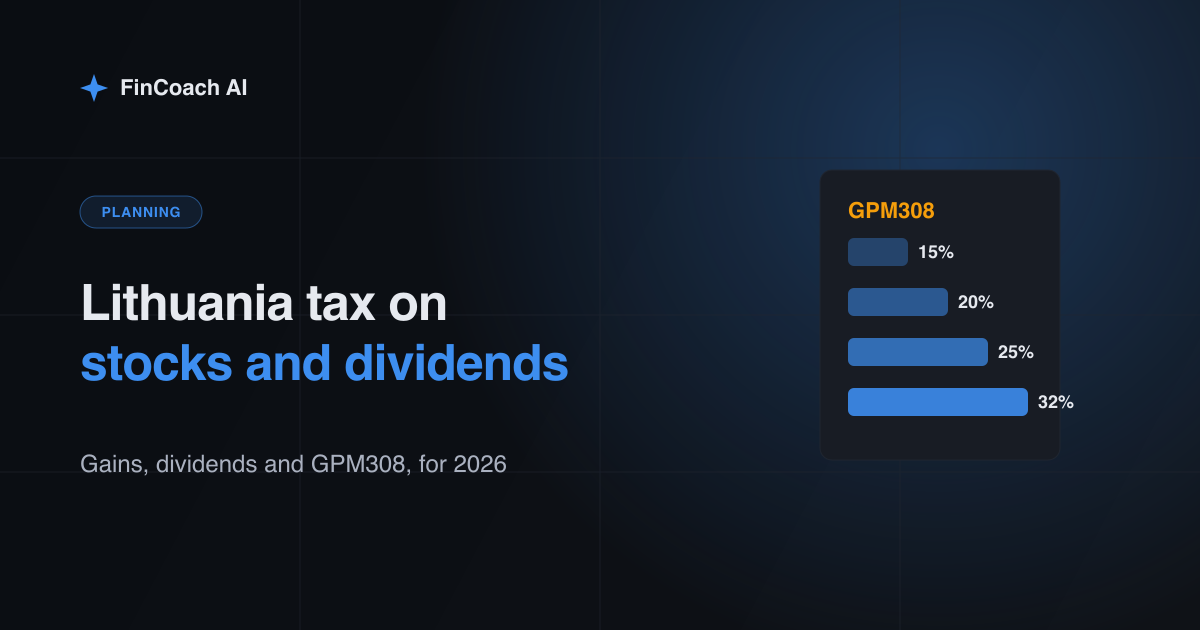
If you live in Lithuania and invest through Interactive Brokers, you generally declare and pay Lithuanian income tax (GPM) on your gains, dividends and interest yourself, because income from a foreign broker isn’t taxed through Lithuanian payroll or withholding. From the 2026 tax year, dividends are taxed at a flat 15%, shares held more than five years are taxed at a flat 15% when sold, and other share gains fall under the new 15/20/25/32% structure, according to the State Tax Inspectorate (VMI).
The rules changed on 1 January 2026, so guides written before then describe a different system. Everything below comes from VMI’s published notes on the change or is marked where we couldn’t confirm it on a VMI page. It’s a map for reading your own statement, and the final word on your return belongs to VMI.
What changed in Lithuanian income tax in 2026?
Lithuania amended its Personal Income Tax Law (GPMĮ) on 26 June 2025 (law No. XV-343), with the changes applying from 1 January 2026. VMI’s explanatory notes, “Mokesčių įstatymų pakeitimai nuo 2026-01-01” (published on vmi.lt), set out the new base rates:
- 20% on the part of annual income up to 36 average monthly wages (VDU).
- 25% on the part from 36 to 60 VDU.
- 32% on the part above 60 VDU.
VMI’s December 2025 version put those thresholds at €82,962 and €138,270, using a projected 2026 VDU of €2,304.50 a month. Later sources use a slightly higher VDU, so treat the euro figures as approximate and check VMI’s current numbers.
Two exceptions matter most for investors. Some income is taxed at a flat 15% and is left out when your annual total is measured against those bands. And income that doesn’t come from employment gets its own 15% band at the bottom, described in the next section.
How are share sales taxed?
It depends mainly on how long you held the shares. VMI’s notes list income from selling shares held more than five years (and not bought through an investment account) among the flat-15% items, so those gains don’t count toward your income bands.
Gains on shares held five years or less are treated as income not from employment. Under VMI’s description, that kind of income is taxed at 15% on the part that, together with your other non-employment income, stays within 12 VDU a year (VMI’s figure: €27,654). Anything above 12 VDU moves into the 20%, 25% and 32% bands, measured against your total annual income.
The taxable amount is the gain (sale proceeds minus acquisition cost and allowable costs such as commissions), not the sale proceeds. Losses, currency conversion and matching sales to specific purchases have their own rules, which this guide doesn’t cover, so check them with VMI.
Is the €500 exemption still there?
Under the pre-2026 rules, the first €500 a year of income from selling financial instruments was tax-free. Swedbank’s March 2026 declaration guide and tax firm Triniti’s April 2026 analysis both say the €500 amount continues under the general regime and doesn’t apply if you use the investment account regime. We couldn’t open VMI’s own page on it, so confirm on vmi.lt before relying on it for 2026 income.
How are dividends from foreign stocks taxed?
Dividends are taxed at a flat 15% in Lithuania, and VMI’s notes say they aren’t added to annual income when working out your band. Dividends in an IBKR account usually come from foreign companies, though, and the source country often withholds its own tax first.
For US stocks, the IRS says dividends paid to non-residents are withheld at 30% or a lower treaty rate, claimed by filing Form W-8BEN with the broker. The IRS treaty table lists the general US–Lithuania rate on dividends as 15%.
Lithuania then lets you deduct the foreign tax from the Lithuanian tax on the same income. According to a 2023 summary by law firm Ellex, only foreign tax at a rate up to the treaty rate can be deducted, and you need proof the tax was paid. With a 15% US withholding and a 15% Lithuanian rate, that usually leaves nothing extra to pay. Without a W-8BEN, the US takes 30%, Lithuania still credits only 15%, and the other 15% is lost unless you reclaim it from the US.
What about interest on cash?
Interest isn’t on VMI’s flat-15% list, so on our reading of VMI’s notes it counts as income not from employment and shares the 15% band with short-term share gains. VMI’s October 2025 notes mention a €500 non-taxable amount for interest on deposits. Whether interest paid by a broker on uninvested cash counts as deposit interest is something we couldn’t confirm, so check with VMI if your IBKR statement shows meaningful interest.
A worked example (hypothetical)
Take a Lithuanian resident with a €30,000 salary whose 2026 IBKR statement shows the following, already converted to euros:
- Realized gains of €4,000 on shares held less than five years.
- €1,000 of gross dividends from US companies, with €150 (15%) withheld by the US because a W-8BEN is on file.
- €100 of interest on cash.
Applying the rules as VMI describes them:
- Gains: €4,000 minus the €500 exemption (if it applies) leaves €3,500. That is well inside 12 VDU of non-employment income, so it’s taxed at 15%, which is €525.
- Dividends: 15% of €1,000 is €150 of Lithuanian tax. The €150 already withheld in the US is credited, so €0 more is due.
- Interest: €0 if it counts toward the €500 deposit-interest amount, otherwise 15% of €100, which is €15.
That’s roughly €525 to €540 owed to VMI for the year. The €30,000 salary is taxed through payroll and doesn’t change these figures here, because the total stays below the 36 VDU threshold. If the same person had no W-8BEN, the US would have withheld €300, Lithuania would still credit only €150, and the extra €150 wouldn’t come back through the Lithuanian return.
How and when do you file?
Income from a foreign broker is declared on the annual income tax return, form GPM308, filed through Mano VMI. VMI’s usual deadline to file and pay is 1 May of the following year. VMI’s notes show the deadline for 2025 income moved to 4 May 2026 because 1–3 May were non-working days, so check VMI for the exact 2027 date for 2026 income. If you find a mistake later, VMI’s notes name GPM311 as the form for correcting a return.
A practical routine is to download IBKR’s annual Activity Statement in January, convert each figure to euros using the method VMI requires, and keep the dividend withholding lines as your proof of foreign tax paid. If your situation includes options, funds that don’t pay out dividends, or many currencies, it’s worth paying a tax adviser for the first year.
Keep these records for each tax year, since they answer most questions VMI could ask:
- The annual IBKR Activity Statement as a PDF.
- Purchase dates for every lot you sold, because the five-year rule turns on them.
- The withholding tax lines for each dividend, as proof of foreign tax paid.
- Confirmation that your W-8BEN was valid for the whole year.
- The exchange rates you used to convert to euros, and where they came from.
How FinCoach AI estimates Lithuanian tax from an IBKR statement
In FinCoach AI, the Trading Patterns tab under Portfolio reads the PDF Activity Statement you download from IBKR (Performance & Reports → Statements → Activity). Alongside total trades, realized P&L, fees and time-weighted return, it shows a “Lithuania Tax Estimate” with:
- Capital gains, with the annual exemption applied.
- Dividends, with the foreign withholding credit.
- Interest.
- An estimated total tax owed.
The card is labelled “informational only, file via Mano VMI (GPM308)”, and that label is accurate. The estimate sees only what’s in the statement you uploaded. It doesn’t know your salary or other income, other brokers or how long you held each lot, so it can’t settle which 2026 rate applies to every gain. Treat it as a first pass that tells you roughly what to expect and which lines of the statement matter, then work through the rules above or with VMI. FinCoach AI is not a tax adviser and doesn’t file anything for you.
Keep reading
- IBKR activity statement explained
- Time-weighted vs money-weighted return
- Getting started with FinCoach AI
- Can AI analyze my portfolio?
Educational, not financial or tax advice. FinCoach AI is not a broker or investment adviser, and AI output can be wrong; check anything important before you act. Figures as of 31 October 2026; sources linked.
Upload your IBKR Activity Statement and see a first-pass tax estimate. Launch the app.
Launch appFrequently asked questions
Do I have to declare IBKR income myself in Lithuania?
Generally yes. Gains, dividends and interest from a foreign broker go on your annual return, and you pay the tax to VMI yourself. Foreign countries may still withhold their own tax on dividends, which can be credited.
What is the tax rate on dividends in Lithuania in 2026?
Dividends are taxed at a flat 15%, according to VMI’s notes on the 2026 changes, and they aren’t counted toward the 20/25/32% income bands. Foreign tax withheld can usually be credited up to the treaty rate.
Do I pay tax on shares held more than five years?
Yes, but under VMI’s 2026 notes the gain on shares held more than five years, outside an investment account, is taxed at a flat 15% and kept separate from your income bands.
Is there a tax-free amount for stock gains in Lithuania?
Banks and tax firms writing in 2026 say the €500 yearly exemption for income from selling financial instruments continues under the general regime. Confirm it on the VMI website for your tax year before relying on it.
When is the Lithuanian tax return due for investment income?
VMI’s usual deadline to file and pay is 1 May of the following year, moved when it falls on a non-working day. For 2025 income it was 4 May 2026. Check VMI for the exact date for 2026 income.
Which form do I use to declare foreign broker income?
The annual income tax return, form GPM308, filed through Mano VMI. VMI may require specific annexes depending on the income type, so follow the prompts in Mano VMI.
This article is for educational and informational purposes only and is not financial, investment, tax or legal advice. FinCoach AI is not a broker or registered investment adviser. Investing involves risk, including the possible loss of capital. Do your own research and consider a licensed professional before acting. See our Terms.