Do Share Buybacks Increase EPS? How to Read the Signal
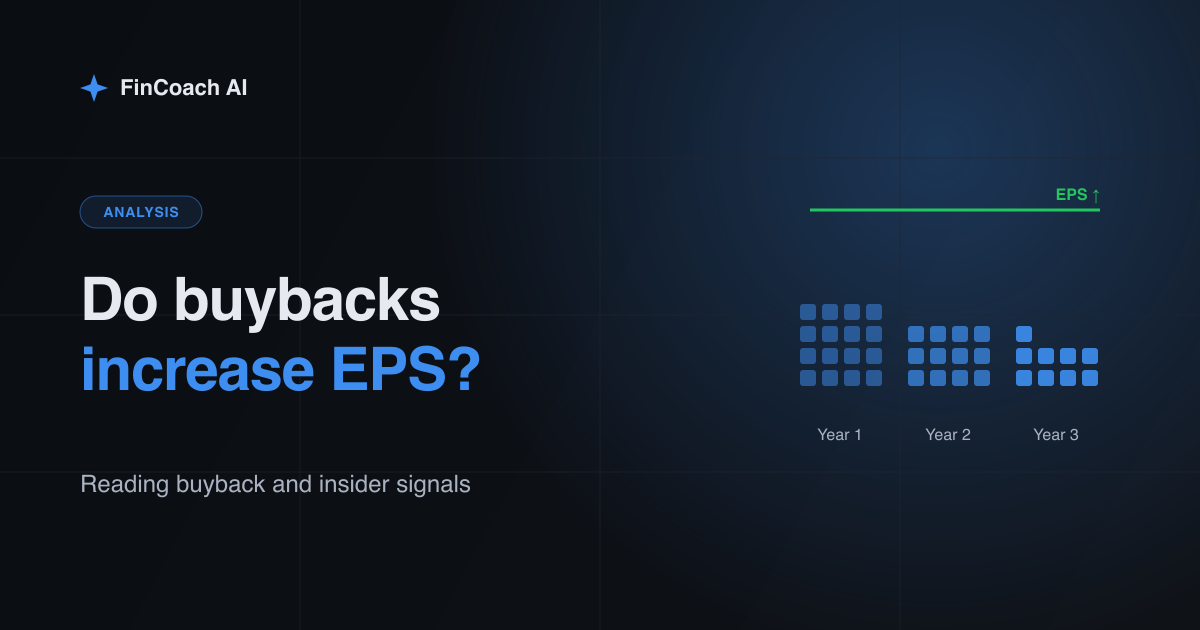
Yes, share buybacks increase EPS whenever they shrink the share count faster than net income falls, because earnings per share is net income divided by shares outstanding. That rise is arithmetic rather than business growth, so the useful question is how much of a company’s EPS growth came from fewer shares and what the buyback cost.
Insider buying is the other half of the signal. When directors and officers buy their own company’s shares with their own money, they have to report it publicly within two business days, and those filings say more than most press releases.
How do buybacks raise EPS?
The SEC’s beginners’ guide to financial statements defines EPS as net income divided by the number of outstanding shares. A buyback leaves the top of that fraction alone and shrinks the bottom. With net income flat at $100 million, cutting the share count from 100 million to 95 million lifts EPS from $1.00 to about $1.053, a 5.3% rise with no change in profit.
That isn’t free money. The company spends cash to buy those shares, and the cash either came from the business, which could have used it elsewhere, or was borrowed. If it was borrowed, the interest reduces future net income, which pulls part of the EPS gain back. And because the P/E ratio is price divided by EPS, a buyback can make the stock look cheaper on that ratio without the business earning more; the P/E guide shows how to adjust for it.
Buybacks can also cancel out rather than shrink anything. Many companies pay staff partly in shares, which adds to the share count every year. A company that buys back 3% of its shares while issuing 3% to employees has spent money and ended with the same count. The share count over five years, not the buyback headline, shows which kind of company you’re looking at.
A worked example: Northwind Robotics’ buyback (hypothetical)
Northwind Robotics is a fictional US company with 100 million shares at $40 and net income of $100 million, so EPS is $1.00 and the P/E is 40. It borrows $200 million at 6% interest and buys back 5 million shares at $40.
- Shares fall to 95 million.
- Interest costs $12 million a year. At an assumed 21% tax rate, the after-tax cost is about $9.5 million.
- Net income falls to about $90.5 million.
- EPS becomes $90.5 million ÷ 95 million = $0.953, down from $1.00.
In this version, the debt-funded buyback lowers EPS, because the after-tax interest (4.7% of the money spent) is higher than the earnings yield on the shares bought (1 ÷ 40 = 2.5%). Fund the same buyback from $200 million of spare cash that earned 2% after tax and the result flips: the lost interest is only $4 million, net income is $96 million, and EPS rises to about $1.011.
The rule that falls out of this is simple. A buyback lifts EPS when the earnings yield on the stock (1 ÷ P/E) is higher than the after-tax cost of the money spent. At a P/E of 40 that yield is 2.5%; at a P/E of 10 it is 10%, which is why buybacks add most to EPS when the shares are cheap relative to earnings. Northwind’s buyback would also owe the 1% US excise tax, about $2 million, unless shares issued that year offset it.
Where do you find buybacks in a company’s filings?
US-listed companies disclose their repurchases in their periodic reports. The SEC’s 10-K guide lists stock repurchases under Item 5 of the annual report, and the SEC requires disclosure of all repurchases in the 10-K and quarterly 10-Q, whether or not they were made under the Rule 10b-18 safe harbor.
Three numbers tell you most of what you need:
- Shares repurchased and the average price paid, from the repurchase table in the 10-K or 10-Q.
- The diluted share count on the income statement, year by year, to see whether the count falls at all.
- Cash spent on repurchases in the financing section of the cash flow statement, set against free cash flow and new borrowing.
If buybacks are larger than free cash flow for several years running, the company is buying back stock with debt or by running down its cash, and that can’t continue forever.
What rules govern buybacks?
Two rules shape how US companies buy back shares. The first is the SEC’s Rule 10b-18, a safe harbor from market-manipulation liability when a company’s purchases meet conditions on manner, timing, price and volume. The volume condition limits total repurchases on a day to 25% of the stock’s average daily trading volume. Meeting the conditions doesn’t protect a company from all liability, the SEC notes.
The second is a tax. Under 26 U.S.C. § 4501, a domestic corporation whose stock trades on an established market pays a 1% excise tax on the fair market value of shares it repurchases. The base is reduced by the value of shares issued during the year, including to employees, and the tax doesn’t apply when repurchases for the year total $1 million or less. It covers repurchases after 31 December 2022, and the Treasury published final regulations on 24 November 2025.
What does insider buying tell you?
Insiders, in the SEC’s definition, are officers, directors and anyone holding more than 10% of a class of the company’s shares. They report trades on Form 4, which is due within two business days of the trade and shows the amount and price per share, according to the SEC’s guide to Forms 3, 4 and 5. All of these filings are public on EDGAR.
Most Form 4 entries aren’t purchases, so read the transaction code before the headline. The codes that matter most:
- P: a purchase on the open market or from another person. This is the insider spending their own money.
- S: a sale on the open market or to another person.
- A: a grant or award from the company, such as stock pay. No money spent.
- M: exercise or conversion of an option or similar derivative.
- F: shares handed back to pay an option’s exercise price or the tax on vested stock.
- G: a gift.
Since rule changes adopted in 2022, Forms 4 and 5 also carry a checkbox showing whether a trade was made under a pre-arranged Rule 10b5-1 plan, and directors and officers must wait at least 90 days after adopting such a plan before trades under it begin, according to the SEC’s fact sheet. A sale that ticks that box was scheduled months earlier.
Purchases and sales don’t carry the same weight. The SEC says many investors see insider purchases and sales as a view on the company’s prospects, and adds that insiders “may sell company securities for any number of reasons, including for liquidity and diversification purposes.” Several insiders buying with code P in the same few weeks says more than one executive’s scheduled sale.
Size matters too. A director buying $20,000 of stock is a weaker signal than a chief executive putting in a sum close to a year’s salary, so compare the purchase with what the insider already owns, which Form 4 also shows. Very small purchases can arrive late: the SEC notes that certain insider purchases under $10,000 in a six-month period can be reported on the annual Form 5, due within 45 days after the fiscal year ends, instead of on Form 4 at the time.
How FinCoach AI shows insider and buyback signals
The Analyze stock report in FinCoach puts both halves of this post on one screen. Enter a ticker or company name, and two sections cover it:
- “Insider & buyback signals” covers insider trading activity and the company’s share repurchases.
- “P/E check” says whether EPS growth came from real profit growth or from buybacks shrinking the share count, and whether the latest profit move looks like a one-off.
Alongside them sits the balance sheet and debt analysis, which helps answer whether a buyback was paid for with borrowing. Each section’s “Ask AI” box answers only from that section’s data, so you can ask “How much did the share count fall over five years?” and get a short answer from Claude, Anthropic’s AI model. Separately, the Discover screen has an “Aggressive Buybacks” ranking built from Financial Modeling Prep data without AI.
Data feeds can lag a filing or simplify its codes, so for anything you plan to act on, open the Form 4 and the 10-K repurchase table on EDGAR and check the counts yourself. AI answers come labelled as a subjective opinion that can be incomplete or wrong.
Keep reading
- Is a high P/E ratio bad?
- How to analyze a stock
- How to read an earnings report
- Verify your decisions before you trade
Educational, not financial advice. FinCoach AI is not a broker or investment adviser, and AI output can be wrong; check anything important before you act. Figures as of 31 October 2026; sources linked.
See the insider and buyback signals for a ticker you follow. Launch the app.
Launch appFrequently asked questions
Do share buybacks always increase EPS?
No. A buyback raises EPS only if the earnings yield on the shares bought is higher than the after-tax cost of the cash spent. A buyback funded with expensive debt at a high P/E can lower EPS, and shares issued to employees can cancel out the reduction in share count.
Are share buybacks good for shareholders?
It depends on the price paid and the source of the money. Buying back shares below their value with spare cash helps remaining shareholders; buying them at a high price with borrowed money can hurt them.
How quickly do insiders have to report a stock purchase?
Officers, directors and holders of more than 10% of a class of shares must file Form 4 with the SEC within two business days of the transaction. The filing is public on EDGAR.
What does code P mean on a Form 4?
Code P marks a purchase on an exchange or from another person, meaning the insider bought shares with their own money. Grants, option exercises and tax withholding use other codes.
Is there a tax on stock buybacks in the US?
Yes. Since 2023, US-listed domestic corporations pay a 1% excise tax on the fair market value of shares they repurchase, reduced by shares issued in the same year. Years with $1 million or less of repurchases are exempt.
This article is for educational and informational purposes only and is not financial, investment, tax or legal advice. FinCoach AI is not a broker or registered investment adviser. Investing involves risk, including the possible loss of capital. Do your own research and consider a licensed professional before acting. See our Terms.